RUD Lifting Solutions in the Singleton Bypass Project.
RUD supplied engineered Philipp Cast-in Lifting Hoops for the $700 million Singleton Bypass Project, supporting the safe lifting and installation of 100-tonne precast concrete bridge girders. The solution improved lifting safety, simplified installation, reduced equipment requirements and helped keep the project on schedule. Early collaboration with RUD’s engineering team also optimised design efficiency, reduced consumable costs and provided fast onsite support throughout the project.
The Singleton Bypass is a $700 million project jointly managed by the Commonwealth and the NSW State Government. The New England Highway carries approximately 26,000 vehicles daily, including over 3,700 heavy vehicles. The bypass will alleviate traffic congestion by circumventing five sets of traffic lights in Singleton's CBD. When finished, it is expected to improve travel times, freight efficiency and safety for local and interstate motorists.
RUD Solutions
RUD supplied Philipp Cast-in Lifting Hoops for the bridge girders, which are a safe and efficient solution for lifting heavy prestressed units such as beams, decks, and girders. The cast in lifting hoops have a fully engineered design and are Working Load Limit (WLL) colour-coded for easy visual checks. They eliminate the need for specialist lifting clutches or equipment, making them simple to use and a more efficient method for large precast elements.
RUD has a team of design engineers to tailor lift designs to specific projects, with a focus on simple installation and safe and efficient final installation, including consideration for temporary works.
RESULTING BENEFITS
Lifting Hoops
Safer to use
Can be inspected easily (no cover/sheath compared to strand lifters)
Easy to install
No heavy and awkward lifting clutches required
Minimal lead time
Easy to handle
Testimonial
"When you are casting 100T concrete girders, there is little margin for error, and big savings can be generated if cost-effective solutions are provided. The benefit of engaging RUD was reflected in the fact that all girders were installed on time and without incident. I could call RUD anytime and they were at my disposal if there were onsite changes or questions.
Getting RUD involved early in the design phase assisted in the optimisation of walkways and produced savings on consumables. RUD are very pragmatic in their recommendations and utilise their extensive experience to problem-solve issues ahead of time.
As a business, we could not have been more impressed with Matt and the team. The advantage RUD provides is a solution-focused engineering team with a quick turnaround time".
Do you want more information on infrastructure solutions? Call us on 07 3809 1300 or email us.
Article copyright to RUD Australia. Pictures are used from Transport for NSW. This information is accurate at the time of publication, and RUD Australia takes no responsibility for any errors, inadvertent or otherwise.
In the challenging world of Australian heavy industry sectors, from construction sites in Sydney or Melbourne to remote mining operations in Western Australia, the safe and efficient operation of heavy material loads is critical. Companies use many products for lifting operations and the two primary ones among them are lifting and spreader beams.
This article delves into lifting and spreader beams, their technical differences and the benefits they add to the job site. We will also discuss how RUD, Australia’s leading lifting equipment provider, caters to clients such as Hulk Lifting and to companies in the crane industry.
What is the Difference between a Spreader Beam and a Lifting Beam?
While both lifting and spreader beams are designed to lift heavy loads, their principles and applications differ. Understanding this difference is key to selecting the right lifting beam or spreader beam for any task.
A spreader beam is a horizontal structure that distributes the weight of a load over multiple points, primarily by converting the lifting forces into compressive stress on the beam itself. The slings from the crane hook attach to the top of the spreader beam, while additional slings connect from the end of the beam down to the load. This ensures the lifting slings remain vertical, eliminating inward horizontal forces that could damage a long, flexible or fragile load. Spreader beams are ideal for lifting long objects like steel girders, pipes or precast concrete slabs, where a wide and stable lift is required to prevent the load from bending, buckling or shifting.
In contrast, a lifting beam is a simple device, typically with a single lifting point in the centre. The lifting beam is designed to withstand bending loads and is used for lifting compact or rigid objects. The load's slings are attached to the bottom of the beam, allowing the load to be lifted from a single overhead point. Lifting beams are useful in situations with low headroom, as their design minimises the vertical space needed for the lift. They are commonly used to lift heavy machinery components, large crates or engine blocks.
In summary, selecting one of the two depends on the load and the space available. A spreader beam is good to manage long, unwieldy loads by distributing forces, while a lifting beam provides a robust, low-profile solution for compact and heavy objects. For any project, consulting with a reputable spreader beam supplier or lifting beam manufacturer is crucial.
Enhancing Safety, Stability and Efficiency
The use of engineered lifting and spreader beams is beneficial beyond just getting the job done. Let’s have a look at the benefits.
Greater Safety: The most important benefit is safety. By distributing the load's weight evenly and preventing concentrated stress points, lifting and spreader beams reduce the risk of equipment failure, dropped loads and injuries. They keep slings from slipping and loads from tilting, creating a controlled and predictable lift. The robust design, in accordance with Australian Standards, provides operators with peace of mind
Increased Lifting Capacity: By spreading the load across multiple points, a spreader beam allows a lifting operation with higher capacity than a single-point lift. This is true for long loads, where the beam's design reduces the stress on the lifting equipment itself, allowing for safer handling of heavier items
Superior Load Stability and Protection: Spreader beams act as a stabilising force, preventing the load from swaying or rotating. This is critical when lifting delicate or irregularly shaped items, as it minimises the risk of damage to the load itself or surrounding equipment. For example, lifting a fragile glass panel or a high-value industrial component with a spreader beam ensures it remains level and secure throughout the entire process
Versatility and Adaptability: Many modern lifting and spreader beams are modular or adjustable, allowing them to be reconfigured for different loads and lifting angles. This versatility means that a single beam can be used for a wide range of jobs, reducing the need for multiple pieces of equipment and saving both time and money
RUD Australia: A Case Study in Engineering Excellence
For decades, RUD has been a global leader in lifting and lashing technology and this expertise is reflected in our Australian operations. Our state-of-the-art 6,000m² facility at 12 Commerce Place in Brisbane is a testament to our commitment to quality and innovation. Our production area is equipped with cutting-edge technology, including a SEVERT robotic welder, laser scanning capabilities and multiple test beds which allow us to design, manufacture and test custom lifting and spreader beams in-house.
The core of our success is our specialised engineering team, which utilises FEA (Finite Element Analysis) software to model and test every beam design before it is manufactured. This rigorous process ensures that each product is robust, optimised for weight reduction and certified. After fabrication, every beam undergoes a physical proof load test to guarantee its performance and compliance. This end-to-end flow in the design and manufacturing process minimises lead times and ensures reliability and safety for clients across the country.
A case study is our work with Hulk Lifting, a Brisbane-based company founded by industry veterans Ben Rose and Mitch Atkinson. We have partnered with Hulk Lifting since its inception in 2008, which is a strong endorsement of our solution-oriented approach. Our collaboration often results in customised lifting beams with specialised RUD lugs. Including a 31.5-tonne capacity W-ABA lug, which can meet specific lifting requirements. This partnership demonstrates how we use local manufacturing and global engineering knowledge to provide bespoke and safe lifting solutions.
Both lifting and spreader beams are critical to safety and efficiency. By embracing technically superior, high-quality lifting equipment, businesses can achieve smoother operations, greater productivity and most importantly, a safer working environment.
For more information on our lifting and spreader beams, call us on 07 3809 1300 or click here to submit an enquiry.
Copyright to RUD: This information is accurate at the time of publication, and RUD Australia takes no responsibility for any errors, inadvertent or otherwise.
Performance and safety are paramount when lifting or moving heavy products. In such conditions, the need for specialised material handling equipment is critical. RUD understands these challenges and offers a range of solutions designed specifically for steel handling.
In addition to the steel handling products, RUD Australia also offers additional solutions for lifting and lashing. From heavy coils to cumbersome beams, our robust and reliable products prioritise safety and efficiency at every stage of your business.
Pacman Coil Tilter: The Pacman Coil Tilter is a small footprint up-ender for tilting steel coils from a vertical to a horizontal bore position, enabling safe loading to an Uncoiler machine.
The Pacman Coil Tilter is driven mechanically and can be stopped with the load in the turning process. RUD offers a standard 6-tonne model with a slewing base, and we can customise it to suit your required tonnage.
Safety features include a start delay switch, audio-visual warning, a ‘deadman’ start switch and fork tyne slots. The Pacman Coil Tilter, with its space-saving design, provides reliable tilting and easy load control.
Click here for more details about the RUD Pacman Coil Tilter, or watch the video here.
Self-Levelling C-Hook: Handle coils easily and confidently thanks to the optimised design and ergonomic handle. We can provide custom options with multiple coil widths and protection pads to minimise product damage.
Click here for more details on the RUD Self-Levelling C-Hook.
Quad Hook: This is used to move large steel coils safely and efficiently. The Quad Hook eliminates the risks of conventional T-hooks and bore tongs as it minimises the likelihood of coil damage from unravelling. The Quad Hook provides peace of mind for safety with four pivoting arms that cradle the coils securely, minimising damage and operator risk.
Spreader/Lifting Beams: RUD’s custom-engineered spreader and lifting beams optimise weight distribution for the safe and efficient lifting of heavy, awkward loads. We design the spreader/lifting beams in-house to minimise lead time and maximise cost-effectiveness. Our beam designs are verified with FEA software, certified by an external engineer, and then proof load tested after manufacture.
Click here for more details on the RUD Speader and Lifting Beams.
Hands-Free Feeder Unit (HFFU): A safe, reliable hands-free system to feed coil from the mandrel into the roll former. The HFFU eliminates the need to feed the coil, thereby preventing injuries manually. It will also increase productivity as the operator needs minimal interaction in the coil feeding process.
Click here for more details on the RUD Hands-Free Feeder Unit.
Coil Car: Move coils safely and simply with our compact yet powerful coil transporters. Coils can be loaded directly on the car with a C-Hook or other loading device, driven towards the uncoiler and height positioned to load over an expanding mandrel. We custom manufacture to suit your requirements.
Safety features include extended wings and safety rail locks for optimal stability.
All RUD products are rigorously tested and certified to meet the highest safety standards. RUD's commitment to safety, quality and sustainability is demonstrated by our accreditations, including ISO 9001, ISO 14001, AS/NZS, ISO 3834.2, ISO/IEC 17025 and AS 45001.
Investing in RUD's steel handling solutions means:
Enhanced safety for your workforce.
Increased productivity and efficiency.
Reduced risk of coil damage and equipment failure.
Customisable options for your specific requirements.
Article copyright to RUD Australia. This information is accurate at the time of publication, and RUD Australia takes no responsibility for any errors, inadvertent or otherwise. Some pictures are for illustration only.
Contact RUD today at 07 3809 1300 or fill out an enquiry form hereto discuss how our specialised equipment can optimise your steel handling requirements and elevate your safety standards.
We have compiled a list of the top 5 lifting and lashing points below:
VLBG-PLUS
The RUD VLBG-PLUS Load Ring comes in standard and variable bolt lengths. VLBG-PLUS has a safety factor of 4:1 and comes fully tested and certified by DGUV. It is designed for use in extreme temperatures ranging from -40?C up to 100?C and maximum temperature of 350?C.
The advantages of VLBG-PLUS:
Rotating combination head with RUD ICE® bolt
ICE® bolt is made from patented steel with corrosion protection
Up to 45% higher WLL capacity (M8 - M30)
Rotates 360° and pivots 180°
Complies with AS 3776:2015 and EN 1677-1
VLBS LOAD RING
The VLBS LOAD RING comes with or without an internal holding spring. It is ideal for multi-directional loading with a safety factor of 4:1 and comes fully tested and approved by DGUV.
The advantages of VLBS LOAD RING:
Easy weld-on design
Forged alloy steel load ring
Comprehensive range of WLL (1.5 ton - 16 ton)
Suspension ring pivots 180° and is adjustable in force direction
Suitable for extreme low temperature of down to -45°C
VRS-F STARPOINT
The VRS-F STARPOINT rotates in the direction of the load. Available in several bolt lengths with corresponding washers and crack detected lock nuts in different threads.
The advantages of VRS-F STARPOINT:
Comprehensive range of WLL (0.5 ton - 32 ton)
Rotates 360°
ICE® bolt is made from patented steel with corrosion protection
Higher WLL than DIN 580 eye bolt
Unique key design for easy installation and removal
Ideal for both axials and angular loading
Stamped with WLL F2
ABA WELD-ON LUG
The ABA comes in both LIFTING POINT and LASHING POINT options which are ideal for construction projects that have constant rotary motion, strong vibrations and shocks. ABA has a safety factor of 4:1 and comes fully tested and approved by DGUV.
The advantages of ABA WELD-ON LUG:
Comprehensive range of WLL (0.8 ton - 31.5 ton)
Patented wear indicators
Circular fillet weld-on design
Safer alternative to current pad eye lifting devices
Manufactured in general accordance with AS 3776:2015 and EN 1677-1
ACP-TURNADO
The RUD ACP-TURNADO with a unique spring mechanism ensures higher safety by automatically rotating in the direction of force transmission. This eliminates the risk of a sudden release of the ring from this position in the direction of force and the resulting jerky dropping of the load - which endangers the load, load handling equipment and lifting system.
The advantages of ACP-TURNADO:
Comprehensive range of WLL (1.35 ton - 16 ton)
Turns in direction of optimal force transmission
Rotates 360° and pivots 180°
ICE® bolt technology
Low profile design
No kinking of the hook
Unique RUD spring mechanism
RUD has a long pedigree of manufacturing chains for over 140 years including 40 years in lifting technology and load securing. When it comes to lifting, securing, or lashing, the world looks to RUD which offers over 700 different lifting and lashing points for all requirements across mining, quarries, transport, and infrastructure.
All RUD lifting and load securing products are made in Germany. Many of the standards used in the lifting and load securing industry originated from RUD, such as the inspection stamp H1 for high strength chains in 1953, approval for Grade 8 (H1-8) in 1972 and approval for Grade 12 (D1-12) for round steel chains in 2007.
Article copyright to RUD, this information is accurate at the time of publication and RUD Australia takes no responsibility for any errors inadvertent or otherwise.
If you want to know how the team at RUD can help you, please call 07 3809 1300 or fill out a form here.
In mining, the size and weight of your equipment has a direct impact on yield and productivity. Our lifting and lashing solutions can increase efficiency and boost productivity.
RUD’s ICE Grade 120 chains are 30% lighter with 60% higher breaking force than Grade 80 chains. They are extremely robust, tough, resilient to sharp and rough edges and ideal for the harsh mining environment. The reduction in weight of more than 30% is a major safety advantage.
ICE Chains are assembled, and proof load tested in Brisbane. All RUD ICE sling assemblies are proof loaded at our 6000m2 facility in Brisbane - meaning you have peace of mind knowing that the sling is safe and able to perform the job it’s designed for - lifting safely.
Material Handling Solutions
RUD designs and produces conveyor systems for use in horizontal, vertical, and inclined applications. Our conveyor and drive systems are highly regarded for their high-performance & low-maintenance needs. RUD conveyor and drive systems offer numerous systems solutions for many applications whether it is for conveying, driving, or lifting. All conveyor and drive systems use round steel chains, forked link chains, screw drives or belts as traction mechanisms.
RUD’s in-house engineers provide concept-to-completion solutions. Our accredited engineers help increase project productivity, efficiency, and safety by designing and delivering bespoke products and solutions. Our engineering team works with our manufacturing team in our 6000m2 Brisbane facility, designing and manufacturing customised engineering solutions for a range of industries.
All our products and solutions are rigorously tested to ensure they meet the high standards. Our quality control systems include compliance with ISO 9001, ISO 14001 and AS 45001.
Some of our testimonials:
“We see our long-term relationship with RUD more as a partnership than supplier and customer. RUD’s service and product support are excellent, and their team of industry specialists is always on hand to answer any of our questions” - Paul Denison, Bullivants Townsville.
“The team at Jilalan appreciate the quality service RUD provided in the design, fabrication, and commissioning of our platforms for our Wagon remediation project. RUD’s attention to detail and great communications skills ensured that our project was completed to the highest standard and exceeded our expectations. From the start of the procurement process, RUD committed to ensuring time frames could be met and delivered quality products as per agreement. We are grateful for this as no other company we contacted could make these commitments” - Gavin Witton Project Leader, CQCN North Wagon Operations, Aurizon.
Article copyright to RUD, this information is accurate at the time of publication and RUD Australia takes no responsibility for any errors inadvertent or otherwise.
Australia is known worldwide as a mining country. Mining has been prevalent with the early settlers who heralded the gold rush in 1850 and were instrumental in bringing development during the early years. Mining is a major contributor to Australian economy, accounting for around 14.6% of the total Australian economy in 2021. For a complete snapshot of the Australian economy, download the Economy Composition Snapshot Chart.
For over 140 years, the RUD Group has been developing innovative chain systems and components for a wide range of applications in the mining sector around the world. In Australia, RUD offers a range of lifting and lashing points, VIP sling chain systems and tyre protection/traction chains for the mining industry.
RUD also offers a range of mining chains and connectors for use in armoured chain conveyors and beam stage loaders, covering all standard sizes, from 14x50mm through to 48x152mm. All sizes can be supplied in round steel link configuration while the flat link style is available only in the 38mm to 48mm size.
Tyre Protection Chains
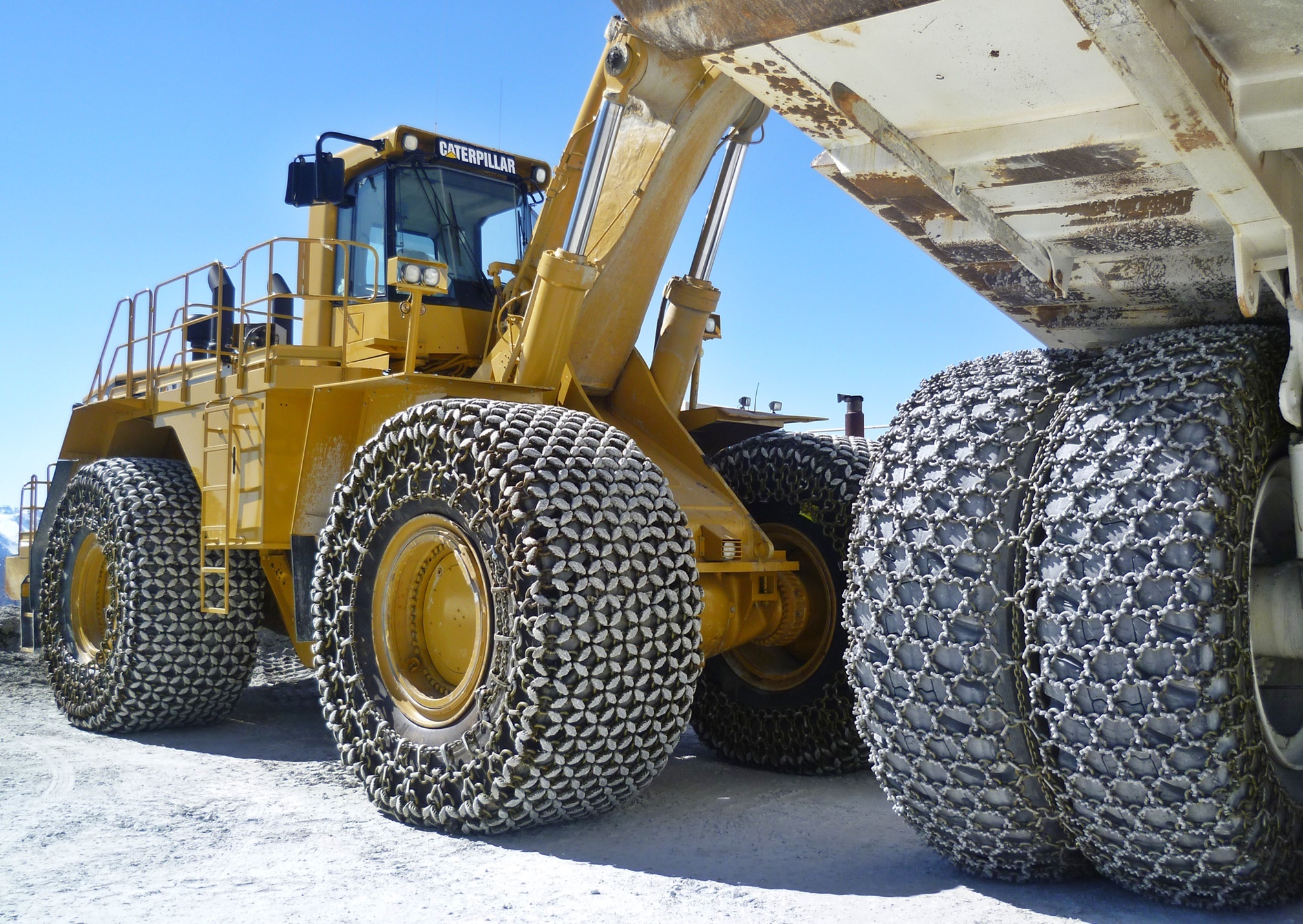
The world reputed RUD tyre protection chains are a sought-after quality product for mining and quarrying trucks.
Tyre Protection Chains are required for 3 broad reasons:
To Maximise Safety in wet and slippery environments
To Reduce Operating Costs by cutting down on expensive repairs and avoiding downtime
To Increase Flexibility and Overall Productivity by using high quality chains across different terrains
RUD’s tyre protection chains:
Use case hardened alloy chains linked in patented designs to provide a high level of tyre protection
Are designed to be used across fire and hot slag conditions, which can be very dangerous and lead to loss of equipment through burnt tyres
Help extend a tyres’ life by a factor of ten
At the Jundee Nickel Mine, extreme tyre wear and premature tyre failure had become an ongoing problem. Tyre issues were frequent but unpredictable. Replacement tyres were often difficult to source, leaving trucks and machinery out of service for long periods of time. RUD offered a solution, read the full case study of the Jundee Nickel Mine.
Continued into Part 2 to discuss lifting, material handling and engineered solutions...
Article copyright to RUD, this information is accurate at the time of publication and RUD Australia takes no responsibility for any errors inadvertent or otherwise.
AT RUD, we understand that productivity, safety and reliability is what creates sustainable value.
With a reputation that is built on quality, professionalism and unrivaled customer service, our team of CPEng/RPEQ engineers and experienced tradespeople can manage, in-house every aspect of your engineered product or service requirements, to ensure you receive only the highest quality RUD solutions in a timely manner.
Our 6000m² Head Office, administration, warehouse and manufacturing facility located in Brisbane has a dedicated manufacturing team to offer complete solutions including:
Horizontal Tensile Testing – standard and special (for very large and complex testing)
Vertical Compression and Tensile Testing
Paint Facility
Small to large fabricated products
Robotic Welding
Hardness Testing
Non Destructive Testing – MPI, Dye Penetrant
Our new catalogue talks more about this and also highlights:
Our range of concept to completion products and systems, all designed, manufactured and certified at our 6000m2 Head Office in Brisbane.
From product certification to Lifting system design and testing RUD delivers cost effective solutions to materials handling problems across a wide range of applications and industries. Take a look
A pictorial gallery of our range of bespoke lifting, rotating and traversing systems designed to suit specific transportation and lifting applications.
Explore our bespoke solutions developed to safely transport, lift and rotate goods, design in a accordance with Australian Standards. Take a look
Why RUD was awarded CICA 2017 Lift of the Year Solution for the Wheatstone Lifting Beam Project.
Working collaboratively with the client and other key supply chain partners, RUD delivered a high quality solution that allowed a safe method of lifting. Take a look
Downloadable on all Devices
To make it an easy reference tool, you can download our Digital Engineered Solutions Guide in one place, so you can save to your device and/or print for future reference.
Talk to us today- we're here to help
Have a project you want to discuss? Why not contact RUD today and speak to us about your requirement-we’d love to hear from you.